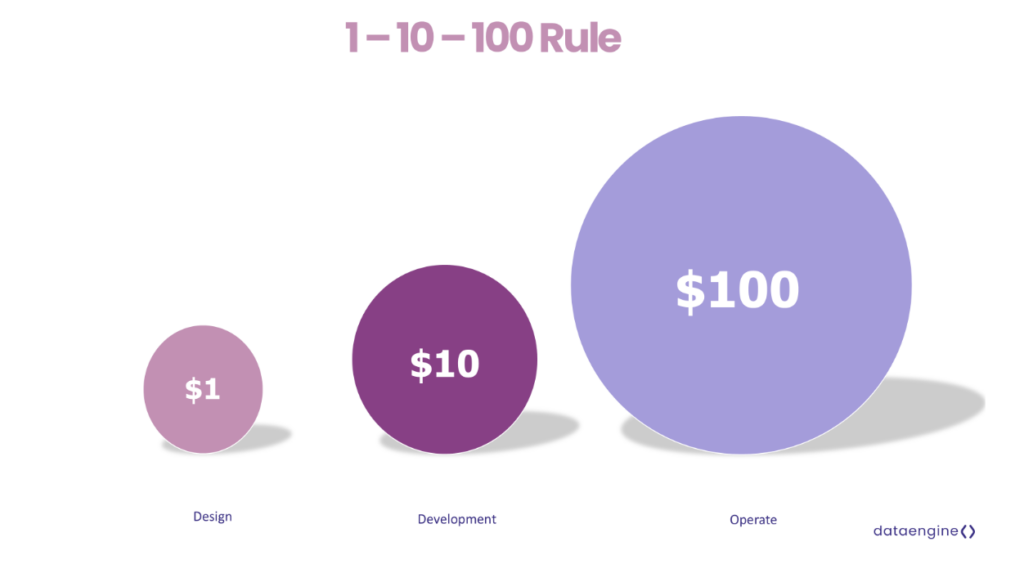
- “Companies typically incur losses amounting to 20–30% of their operating costs annually due to inefficiencies stemming from rework, coordination challenges, and delays.” – Maurice Adam Weber
- A McKinsey study of 1,000 companies found that those with the fastest decision cycles outperformed peers by 2.5x in revenue growth.
- “The cost of bad data to be 15% to 25% of revenue for most companies” – Thomas C. Redman
Based on our analyses, for a $10m‑revenue organisation, that equates to $200k–$400k per year and over 5 periods, saving around $2.34m driven by quicker decision-making, improved quality of data and headcount avoidance.
For more than a decade, organisations have invested heavily in Business Intelligence. From a finance perspective, this investment has generally been justified as a necessary cost of visibility, control, and reporting compliance. Platforms were modernised, governance embedded, and specialist teams built to ensure consistency and accuracy.
Yet despite this maturity, the economics of insight have quietly worsened. The cost to produce answers remains high, demand continues to outpace resource capacity, and decision latency carries a growing financial penalty. For the C-suite, the core issue is no longer whether data exists, but whether the operating model can manage the demand and risk of doing nothing is high.
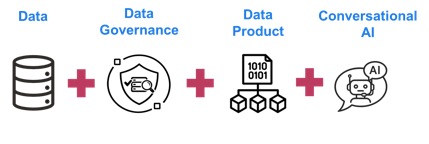
Federated Access addresses this problem directly. It reframes analytics not as a reporting function to be scaled through headcount, but as a governed access model with conversation AI that lowers marginal cost, shortens decision cycles, and improves return on data investment. Federated access is the following
| Pillar | What it is | Why it matters |
| Data | Raw operational, financial, and external information generated across the organisation | Provides the factual foundation for reporting and decisions, but has limited value on its own |
| Data Governance | The rules, ownership, and controls that manage access, quality, security, and compliance | Ensures data is trusted, auditable, and safe to use at scale without slowing the business |
| Data Product | Curated, business ready datasets built around specific use cases with fixed definitions | It is an automated, reusable business asset that manages security access appropriately and reduces the risk of AI hallucination. |
| Conversational AI | A natural language interface that allows users to ask questions of data products directly | Removes report dependency and delivers fast, explainable insight within governed boundaries |
The Hidden Financial Cost of Traditional BI
For executives, the highest cost of BI is rarely software licensing. It is organisational friction.
Even a straightforward query can trigger weeks of elapsed time across analysts, finance partners, and business stakeholders. While the labour cost is often absorbed into existing teams, the financial impact is real: delayed revenue actions, slower cost interventions, and increased reliance on judgement calls made without evidence.
Over time, this manifests as three compounding costs:
- Escalating labour spend as specialist teams grow to meet demand
- Shadow analytics costs through spreadsheets, extracts, and duplicate effort
- Cost of delay, where decisions are made late or not at all because waiting is more expensive than guessing
The challenge is that traditional BI scales linearly. Each new question creates incremental labour: requirements gathering, report development, validation, and rework. As demand rises, cost rises with it. Fully loaded data specialists typically cost $130k–$180k per annum, and report portfolios expand faster than they can be rationalised.
Federated Access – The Savings
For a $10m revenue organisation, Business Intelligence spend typically amounts to $200k–$400k per year once people, tooling, and delivery overhead are included. Despite this investment, many organisations still experience long lead times, report backlogs, and decisions made late or based on intuition rather than evidence.
Federated Access changes the economics by altering how insight is produced and consumed. Instead of scaling analytics through headcount and dashboards, it reduces friction at the source, making insight easier to access, faster to act on, and cheaper to scale.
Our model follows a simple principle: identify where value leaks today, then count only the portion that Federated Access can realistically influence.
- Decision quality improvement is calculated by taking a small percentage of revenue affected by suboptimal decisions and applying a conservative influence factor to reflect partial improvement, not perfection.
- Decision delay reduction converts time into money by spreading revenue across working days, then valuing the impact of decisions made earlier rather than later.
- Data quality improvement starts with the known cost of poor data today and scales it based on how much quality improves and how much of that improvement is actually realised.
- Headcount avoidance reflects future roles that no longer need to be hired as insight demand scales without linear growth in analysts.
Each benefit is calculated independently, phased in over time to reflect adoption, and combined to produce a realistic annual benefit, not a theoretical maximum
Summary of annual savings for $10m organisation
| Source of value | Indicative annual impact |
| Headcount avoidance | $159,000 |
| Visualisation & reporting tool savings | $18,000 |
| Decision delay reduction | $120k –180k |
| Decision and data quality improvement | $88k – 120k |
| Total annual benefit | $440k + |
Below are the benefits explained better
| Benefit area | What improves | Why it matters financially | How Federated Access drives it |
| Decision quality improvement | Decisions are made using consistent, trusted numbers instead of partial reports or intuition | Fewer corrective actions, less rework, reduced value leakage from pricing, forecasting, and investment decisions | Certified data products define metrics once; AI explains drivers and tradeoffs using governed data |
| Decision delay reduction | Time from question to answer reduces from weeks or days to minutes | Earlier action on revenue, cost, and risk directly impacts P&L; cost of delay is avoided | Selfservice access and conversational AI remove report queues and analyst dependence |
| Data quality improvement | Data issues are fixed once at the source, not repeatedly reconciled downstream | Lower finance effort, fewer reconciliations, tighter closes, higher confidence in management reporting | Clear domain ownership of data products with embedded quality rules and accountability |
| Headcount avoidance | Insight demand scales without hiring analysts at the same rate | Avoids future fixed costs while analytical capability continues to grow | Central teams shift from report delivery to enablement, standards, and governance |
| Visualisation & reporting tool savings | Fewer licences needed as self-service and federated reporting reduce dependency on multiple tools | Direct cost savings from the consolidation of visualisation/reporting platforms | Federated Access enables a conversation AI to create reports and insights |
Federated Access Is an Operating Model, Not a Tool
It is tempting to frame Federated Access as a platform decision or an AI capability. For CFOs, this framing is incomplete and potentially misleading. Federated Access is first and foremost an operating model, underpinned by clear practices, roles, and architectural patterns that change how insight is produced and governed.
At its core, Federated Access combines three elements:
- Operating model – Clear ownership of data products by business domains, with explicit accountability for definitions, quality, and financial meaning
- Good practices – Standardised ways of working for data product design, certification, access control, and lifecycle management
- Enabling architecture – Platforms and AI capabilities that enforce governance by design, rather than policing it after the fact
Tools enable this model, but they do not define it operationally. Below is the four ingredients required to make Federated Access for AI successful.
From a finance perspective, this distinction matters. Tool‑led analytics initiatives often add cost without changing behavior. Operating‑model changes, by contrast, alter incentives, accountability, and unit economics.
What Changes Under a Federated Access Operating Model
When Federated Access is implemented as an operating model, several financially material shifts occur:
- Ownership moves closer to value creation – Data products are owned by domains that understand revenue, cost, and margin drivers, reducing translation loss and reconciliation effort. In the age of AI, this is more important as businesses understand what is right and wrong.
- Central teams shift from delivery to enablement – Teams focus on standards, controls, and platforms rather than bespoke report production
- Governance becomes embedded – Controls, access rules, and definitions are enforced through the platform and decision governance forums, lowering the ongoing cost of compliance and audit
- AI operates on trusted assets – Insight generation scales without increasing risk, because AI is constrained by certified data products and policies
For CFOs, the implication is clear. The value of Federated Access does not come from selecting the right analytics or AI tool. It comes from deliberately redesigning the operating model so insight scales with control, cost discipline, and financial accountability.
How Federated Access Changes the Cost Structure
Federated Access removes the full need for report creation as the primary cost driver. Finance leaders and executives interact directly with governed data products, while AI provides interpretation, variance explanations, and scenario context in real time.
This has immediate financial implications:
- Fewer bespoke reports need to be built and maintained
- Analytics demand is met without proportional headcount growth
- Insight becomes available earlier, reducing the economic impact of delay
What are the benefits areas?
| Benefit area | What changes | How you measure value |
| Decision latency | Faster access to governed answers | Days reduced × decision impact |
| Cost of delay | Earlier revenue and cost actions | Delay avoided ($) |
| Reporting spends | Reduction in bespoke report development | Reports avoided × cost per report |
| Headcount avoidance | Analytics scales without linear hiring | Roles avoided vs plan |
| Decision quality | Greater use of evidence | Reduction in rework and corrective actions |
| Data quality | Issues fixed once at the source | Fewer reconciliations and manual overrides |
| Spend predictability | Shift to per‑user access costs | Forecast variance reduction |
Crucially, this does not weaken control. Access is role‑based, usage is auditable, and definitions are locked at source. AI operates within finance‑approved constraints, not outside them.
Final Thought
Federated Access delivers significant organisational and financial benefits, but only when it is treated as a living operating model rather than a one-off deployment. The primary risks do not stem from decentralised access itself, but:
- Incomplete implementation
- Poor definition of data products
- limited business ownership and data governance
- Lack of business training on how to use AI
- No central enablement and optimisation
- Unmanaged growth in AI usage
Mature organisations address these risks by continuously improving data products and AI interactions, investing in business capability, establishing a centre of enablement, and actively managing AI usage patterns. When executed well, increased usage and AI interaction are indicators of success because the focus shifts from minimising cost per query to maximising organisational value per decision. Federated Access is powerful but not a proof of concept, they are not a proof of concept, but a way of working. When it underdelivers, it is almost never because the idea is wrong; rather, it’s because the operating model is only partially implemented. The risks listed below are the ones I most frequently encounter. Importantly, none of these is a reason not to adopt Federated Access; they are reasons to implement it properly.
Come talk to us about how we can measure the savings for your organisation and understand how to successfully implement Federated Access as an operating model.