This blog aims to outline my perspective on the future of Business Intelligence (BI), which I believe will be characterised by a hybrid approach with AI as a tool. My vision is that users will be able to query their data using both AI and BI tools. This represents a scalable and cost-effective solution for businesses of all sizes, eliminating the need to hire large data teams while also enhancing decision-making. Furthermore, I contend that Federated Access for AI and BI offers an operating model well-suited to supporting business objectives amid the current pace of change.
My point of view is that Federated Access is shaped by delivery, not theory. I’ve implemented largescale data mesh programmes using decentralised operating models, where business domains own data products, definitions, and outcomes. This approach has proven highly effective for analytics and BI, especially in organisations with diverse business models, where it is driving better quality, clearer ownership, quicker delivery, leading to faster decisionmaking.
As organisations move from BI into AI, I’ve learned that pure decentralisation doesn’t always scale safely, and BI isn’t scalable. AI introduces higher risk, greater operational complexity, and stronger requirements for shared guardrails. That’s why we advocate a blended operating model, which we call Federated Access.
My belief is simple: define the operating model first, then design the platform architecture to support it. When organisations reverse this order, they often end up with powerful platforms but poor adoption and thus limited value. That’s why dataengine advocates a blended operating model, which we call Federated Access. And the need for it has never been more urgent, especially in New Zealand and Australia, where resources are scarce and require significant investment.

The Reality in New Zealand and Australia
Specialist data and AI skills are scarce. At the same time, demand for data, analytics, and AI has exploded, driven by self-service expectations, natural language querying, and AI becoming embedded in day-to-day operations.
Many organisations are still delivering analytics and AI as one-off solutions: custom datasets, bespoke models, and rebuilt pipelines for similar questions. In smaller markets, this creates a high cost to serve for every new use case. Data teams can’t keep up, backlogs grow, and scaling usually means hiring more people rather than creating more leverage.
These challenges aren’t temporary. They’re structural. Which is why the operating model matters more than the technology to get success and scale.
Why Centralised AI Struggles to Scale
Most organisations started by centralising everything:
- One data team
- One AI team
- One set of backlogs
- One approval path
Initially, this feels safe and controlled. In practice, it quickly leads to:
- Bottlenecks forming almost immediately
- Long wait times for even simple insights
- AI solutions that technically work but don’t fit real workflows
- Data teams overwhelmed by demand, context switching, and rework
The further AI is from the people who understand the data and the decisions it supports, the less effective it becomes. Federated Access is a modern operating model for Data and AI, enabling organisations to scale insight and intelligence without central bottlenecks or loss of control.
What Federated Access Actually Means
Federated AI isn’t a tool or a product. And it’s not chaos. It’s an operating model that provides a modern, scalable way for organisations to use data and AI safely while empowering business domains to take real ownership of their information. Rather than centralising all control within a single team, the model distributes responsibility to the people closest to operational work while maintaining strong enterprise governance and security through the central data platform. This approach ensures that data products are developed with context, accuracy, and accountability, and that they can be shared across the organisation in a trusted and consistent form.
At its core:
Ownership of data and AI outcomes sits with business domains, while platforms, governance, and guardrails remain centralised. The experience is similar to ChatGPT or natural language query on a controlled data set at an operational level.
This balance is what enables speed and control. This overtime improves scalability of teams and maintains lower operational costs.
What Changes for the Business? And Is BI No Longer Required?
This is the part where organisations underestimate the case for change.
With Federated Access with AI:
- Business teams stop being reactive consumers
- They become accountable owners
- AI moves from “interesting experiments” to operational tools for day-to-day decision making
Users now have the ability to:
- Ask questions about their own data
- Validate outputs quickly
- They can identify data quality issues and manage the change back into the business
- Iterate faster without waiting on central teams
Business intelligence has a place, but we see it as the backbone of trusted reporting and performance management. Over time, we see organisations scale to more AI-generated charts and insights.
Why Ownership Matters More Than Model Complexity
AI succeeds not through complex models, but through clear ownership.
When domains own their data products:
- Definitions are clearer
- Data quality improves faster
- Issues are detected earlier
- AI outputs are trusted and acted on
When ownership sits too far away, every AI result becomes a debate. Federated AI closes that gap by putting accountability where the knowledge already exists. But this requires good data governance practices, and I personally see organisations that have invested in data governance will be ahead of the curve.
Data Products are The Foundation
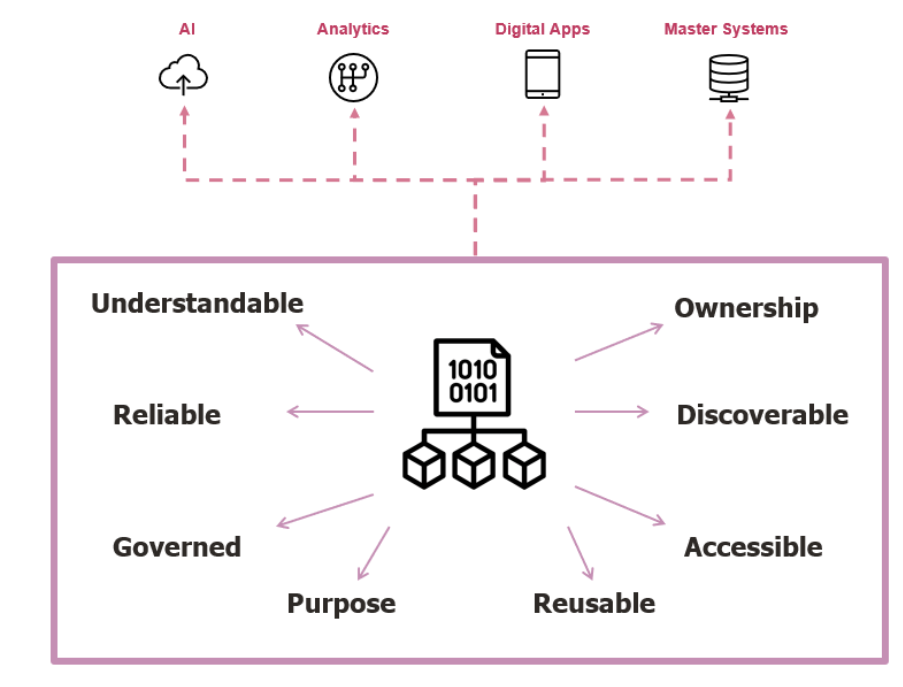
Data products are essential for federated access in AI because they organise and manage data within individual business domains, ensuring that teams can access high-quality, well-defined information without relying on a central authority. With federated access, data remains under the control of those who understand it best, which is the business teams; they decide who can access their data and how it is used. This approach eliminates bottlenecks caused by centralised data management and allows for faster development, experimentation, and innovation, all while maintaining robust security and privacy controls. That means:
- Trusted, well-defined “gold” datasets
- Clear semantic models and shared definitions
- Explicit access and usage rules
Federated Access for AI should never point directly at raw, uncontrolled data. It should sit on governed data products that are auditable, safe, and fit for purpose.
What Stays Central
Federated Access does not mean centralising all capability, it just means data becomes a shared responsibility as AI can provide quicker results.
Central teams still own:
- Platforms and architecture
- Security, privacy, and Responsible AI
- Standards and guardrails
- Cost, risk, and observability
Their role shifts from building everything to enabling everyone to safely use AI for analytics
Final Thoughts
The organisations that will win with AI aren’t the ones with the flashiest models.
They’re the ones that:
- Put ownership where the knowledge sits
- Build strong, reusable data foundations like security and accountability
- Enable speed without losing control
Federated AI isn’t a trend in this era, but it’s a response to reality. Get the operating model right, and the technology finally starts to work for you.
We have successfully implemented Federated Access on Snowflake. Talk to us if you want to know more about it.